
Five Things I've Learned...
. . . about “subtly maneuvering” the creative process, live on October 23rd.

Note: This talk took place on October 23, 2025, but you can watch the recording anytime here.
Hi, everyone — Just a quick reminder of my upcoming class, Five Things I’ve Learned About Subtly Maneuvering the Creative Process, taking place live tomorrow evening at 5pm Pacific / 8pm Eastern time.
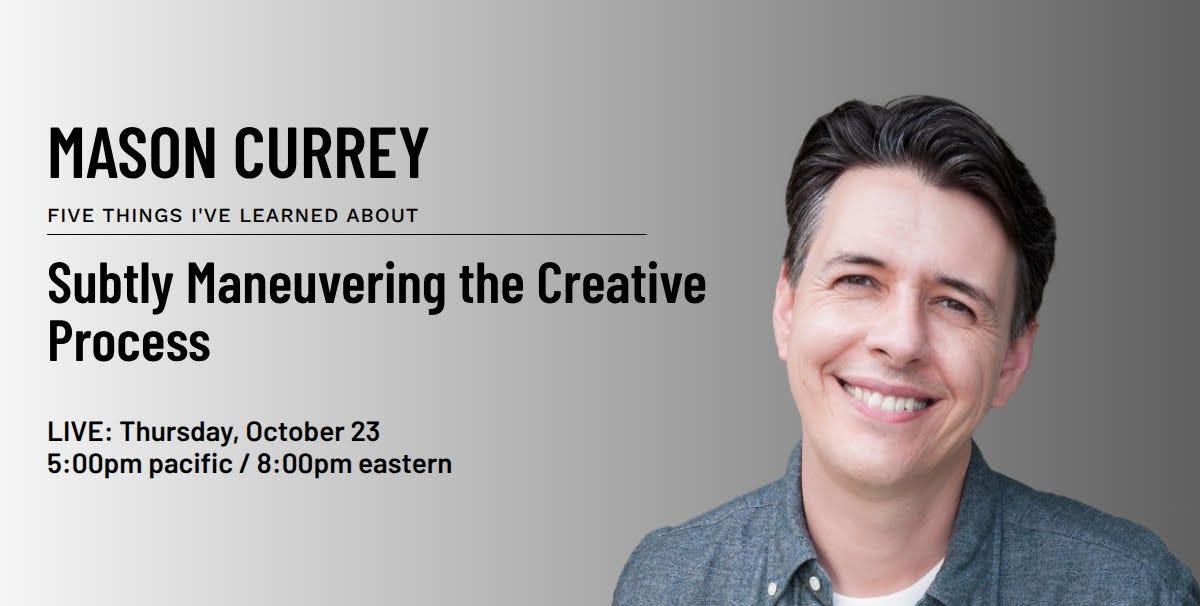
For more than fifteen years now, I’ve been reading and writing about how a variety of brilliant people—writers, artists, musicians, and others—got their work done, both at a very basic level (how they made time for their work and kept showing up for it over the long haul) and in more ephemeral ways (how one’s ambitions, temperament, and work process can cohere into something bigger than oneself, sometimes).
In this class, I’ll be unpacking my biggest takeaways from all this research, and talking specifically about what habits and attitudes we might all try to adopt in our own creative lives.
Tickets are $60, but newsletter subscribers are welcome to take $10 off with the discount code SUBSTACK10.
And if you can’t make it to the live class tomorrow evening, don’t worry: there will be a recording available shortly afterward.
Below is my full invitation to the class, plus a brief video message from my writing cave. I’m really excited for this and hope to see some of you there! (And I’ll be back with a normal newsletter issue next Tuesday.)
—Mason
Hi, I’m Mason Currey. I’m a writer who has always been fascinated by how creative people—writers, artists, musicians, filmmakers, and others—get their work done, and I’ve been really fortunate to turn this fascination into the center of my own writing life.
I’ve published two books—Daily Rituals: How Artists Work and a sequel, Daily Rituals: Women at Work—with brief profiles of how more than 300 brilliant minds organized their days in order to be creative and productive. In them, I described Beethoven’s precise coffee-drinking regimen, David Lynch’s afternoon milkshakes at a Los Angeles diner, Maya Angelou renting a “tiny, mean” hotel room to do her writing, and many more idiosyncratic routines and habits. And for the last five-plus years I’ve been writing a newsletter that continues this project, albeit in a looser fashion. (It’s called “Subtle Maneuvers”—more on that phrase below.)
This isn’t an academic exercise for me, or just highbrow voyeurism. Truthfully, I’ve always found writing really hard. All too often, I have avoided my work, put things off until the last minute, and finished projects only thanks to a burst of deadline panic. I have been blocked, mired in self-doubt, and wondered if I’m cut out for this work at all.
So all of my reading and thinking about how successful creative people got their work done—it was my sideways attempt to figure out better habits for myself and, more broadly, to develop some confidence as a writer and a creative human being. I felt like if I could see how others have navigated the obstacles in their creative lives, I could—perhaps—do the same in mine.
And the thing is: It has worked. Gradually, I have built up a writing practice that I find deeply rewarding. Just in the last few months, I finished my third book. And through my newsletter I have been really fortunate to connect with others who have drawn strength and found inspiration and validation in these stories, too.
So this class if for all the creators out there dealing with middling self-confidence, not-so-great habits (or no habits at all), creative blocks, and other very common dilemmas, and wondering if there’s any hope for them. There is! And it’s for anyone who wants to find more room for creative expression in their lives, and see where that might lead.
The class title comes from a letter Franz Kafka sent in 1912. He wrote:
“Time is short, my strength is limited, the office is a horror, the apartment is noisy, and if a pleasant, straightforward life is not possible then one must try to wriggle through by subtle maneuvers.”
I first encountered this passage years ago when I was going through one of my periodic writing funks, and I felt so strangely cheered, almost elated. One must try to wriggle through by subtle maneuvers—of course! What else is there to do? And I think this approach is especially valuable for creative projects, where progress tends to accrue gradually, through small increments of work and through small shifts in our attitudes and habits.
So: This class is about those small shifts and how we might implement them in our own work and lives. I’ll be covering pragmatic stuff around habits and routines, and also more ineffable ideas around how to best orient ourselves toward this funny, unpredictable, important work—in short, how to forge a productive relationship with the creative forces.
In the class, I’ll share what I’ve learned by paying careful attention to the creative practices of Virginia Woolf, John Cage, Vincent van Gogh, and others. Whether you already have an established creative practice or dream of having one—or just enjoy hearing about how a variety of brilliant folks achieve their best work—I will do my best to leave you with new ways to think about the creative process, new strategies to try out in your own lives, and a wealth of stories about how some of history’s greatest artists and thinkers have navigated many of the same challenges we all face.
Please join us!
Do you know about Patrick Modiano's writing routine? If not here is some info :https://taquitomedia.substack.com/p/astuces-ia-et-cv-pirater-lalgorithme (in french !)